News Asia
China Launches ‘Grey-Zone’ Warfare to End Self-Governing Taiwan
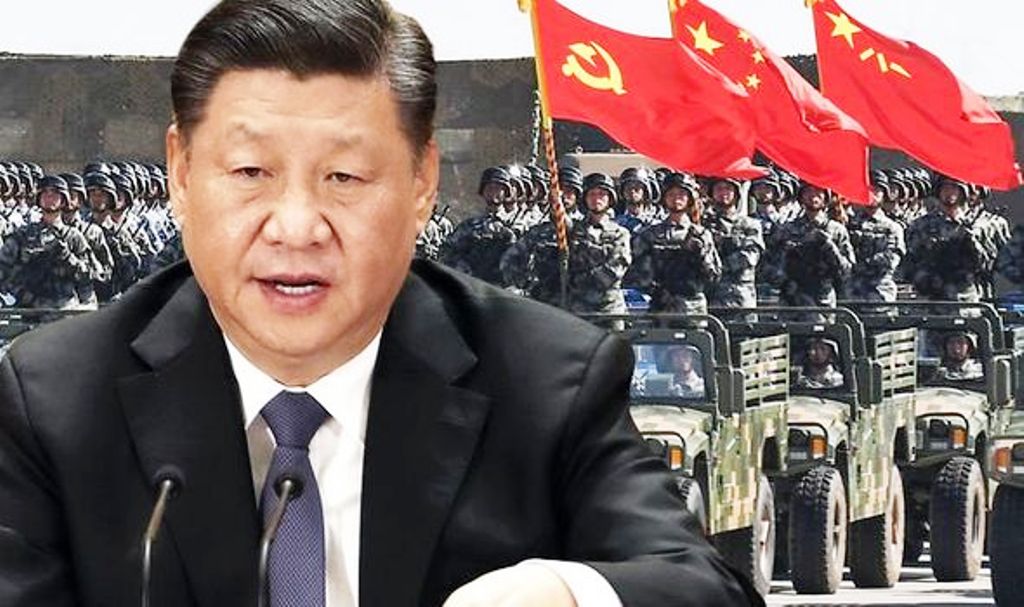
Months after eliminating a popular challenge to its rule in Hong Kong, China is turning to an even higher-stakes target: self-governing Taiwan. The island has been bracing for conflict with China for decades, and in some respects, that battle has now begun.
It’s not the final, titanic clash that Taiwan has long feared, with Chinese troops storming the beaches. Instead, the People’s Liberation Army, China’s two-million-strong military, has launched a form of “gray zone” warfare. In this irregular type of conflict, which stops short of an actual shooting war, the aim is to subdue the foe through exhaustion.
Beijing is conducting waves of threatening forays from the air while ratcheting up existing pressure tactics to erode Taiwan’s will to resist, say current and former senior Taiwanese and U.S. military officers. The flights, they say, complement amphibious landing exercises, naval patrols, cyber attacks and diplomatic isolation.
The risk of conflict is now at its highest level in decades. PLA aircraft are flying menacingly towards airspace around Taiwan almost daily, sometimes launching multiple sorties on the same day. Since mid-September, Chinese warplanes have flown more than 100 of these missions, according to a Reuters compilation of flight data drawn from official statements by Taiwan’s Ministry of National Defense. The data shows that in periods when political tension across the Taiwan Strait peaks, China sends more aircraft, including some of its most potent fighters and bombers.
China accelerates the development of forces
These encroachment tactics are “super effective,” Admiral Lee Hsi-ming, who until last year was the commander of the Taiwanese military, told Reuters in an interview. “You say it’s your garden, but it turns out that it is your neighbor who’s hanging out in the garden all the time. With that action, they are making a statement that it’s their garden – and that garden is one step away from your house.”
Under President Xi Jinping, China has accelerated the development of forces the PLA would need one day to conquer the island of 23 million – a mission that is the country’s top military priority, according to Chinese and Western analysts. With Hong Kong and the restive regions of Tibet and Xinjiang under ever-tighter control, Taiwan is the last remaining obstacle to the Communist Party’s monopoly on power. In a major speech early last year, Xi said that Taiwan, which Beijing regards as a Chinese province, “must be, will be” unified with China. He set no deadline but would not rule out the use of force.
There has been a “clear shift” this year in Beijing’s posture, a senior Taiwanese security official responsible for intelligence on China told Reuters. Chinese military and government agencies have switched from decades of “theoretical talk” about taking Taiwan by force to debating and working on plans for possible military action, the official said.
In a speech Tuesday, Taiwanese President Tsai Ing-wen alluded to the shift. The island democracy is under unrelenting pressure from “authoritarian forces,” she warned, without going into detail. “Taiwan has been at the receiving end of such military threats on a daily basis.”
Admiral Lee, the retired Taiwanese military chief, believes the only thing holding back the PLA from a full assault is that it hasn’t yet achieved the overwhelming firepower needed to overrun the island. Even so, China’s military build-up over the past 20 years means it is now “far ahead” of Taiwan, he said. “Time is definitely not on Taiwan’s side,” he said. “It’s only a matter of time for them to gather enough strength.”
Cold War mentality
The Chinese government was asked detailed questions for this article, including queries about the gray-zone tactics and its overarching strategy on Taiwan. In a written statement, China’s Taiwan Affairs Office said Beijing is committed to “peaceful reunification” with Taiwan, a formulation it has used for decades. It added that “so-called experts’ remarks quoted in the story by Reuters are groundless, purely hearsay, and full of prejudice and show a Cold War mentality.” It continued: “They even include absurd remarks about the country’s central leadership. We are strongly dissatisfied with and firmly opposed to such reports.”
Taiwan’s defense ministry said in a statement it is stepping up naval and air patrols and improving combat readiness to counter China’s gray-zone tactics. The military “sticks to the firm stance of ‘not provoking and not being afraid of the enemy,’ and the principle of ‘the closer they get to the main island, the more active is our response.’”
As the threat mounts, the Taiwanese military is in poor shape to meet it.
Interviews with current and former Taiwan government officials, serving and former military officers, conscripts, reservists and U.S. and other foreign military experts point to dire weaknesses. With the exception of some elements of Taiwan’s military, including the air force, special forces and parts of the navy, decades of isolation and underfunding by successive governments have left the military hollowed out.
Shoring up the island’s defenses
In any Chinese invasion, much of the island’s expensive hardware would be unlikely to survive a barrage of PLA precision missiles and air strikes, current and retired Taiwanese officers say. Crack, resilient ground forces would be crucial to repel beach landings by Chinese troops and counter airborne assaults, they say.
In addition, Taiwanese service members and Western observers say, Taiwan is suffering a serious and worsening decay in the readiness and training of its troops, particularly its army units.
One army conscript told Reuters he had only fired between 30 and 40 rounds with his rifle during training and was never taught how to clear a jammed firearm. “I don’t think I’m capable of fighting in a war,” said Chen, the soldier, speaking on condition his full name not be disclosed. “I don’t think I’m a qualified soldier.”
President Tsai is coming under pressure at home and in Washington to shore up the island’s defenses. Her government is planning to increase defense outlays by more than 10% next year to T$453.4 billion ($16 billion), according to a Reuters calculation based on government figures.
“The military has been whittled down,” said Grant Newsham, a retired U.S. Marine Corps colonel who spent most of last year on the island evaluating its defense capability in a Taiwan government-funded research project. “It is almost as if fighting to defend the country is somebody else’s responsibility,” said Newsham, now a researcher at the Japan Forum for Strategic Studies.
Last outpost of resistance
Taiwan’s defense ministry rejected the idea that it couldn’t defend itself or that its expensive hardware wouldn’t withstand a Chinese attack. The island’s air defenses have been bolstered and its “asymmetrical and mobile combat capacity” has been reinforced, the ministry said in a written response to questions.
Taking Taiwan would be an even greater feat for Xi than putting down the democracy movement in Hong Kong, but also a far greater challenge.
PLA troops have been garrisoned in Hong Kong since the city returned to Chinese rule in 1997. Yet the city’s protest movement was quashed this spring not by military force, but by a combination of aggressive policing, the imposition of a draconian national security law and the eruption of the COVID-19 pandemic, which enabled the government to ban all mass gatherings.
For Xi, democratic Taiwan is now the last outpost of resistance to his dream of a unified and rejuvenated China that can displace the United States as the major power in the Asia-Pacific region. Taiwan has remained effectively independent since 1949, when Chiang Kai-shek’s defeated Republic of China government retreated to the island after the Chinese Civil War.
Bringing Taiwan under Beijing’s wing would give the PLA a commanding position in Asia. It would entrench the Chinese military in the middle of the so-called first island chain – the string of islands from the Japanese archipelago in the north, down to the Philippines and on to Borneo, which enclose China’s coastal seas.
Gray-zone tactics
The PLA Navy could dominate the shipping lanes to North Asia, giving Beijing a powerful lever over Japan and South Korea. And the PLA Navy would have free access to the Western Pacific.
Standing in the way of that dream is the United States. It would be catastrophic to America’s dominance in the region if Chinese forces took control of Taiwan, most military analysts believe, whether by gray-zone tactics or full-scale invasion. America’s global prestige and role as security guarantor in Asia would be shattered, they say.
Already, Beijing’s recent assertiveness, including its fortification of contested islets in the South China Sea, has galvanized an American-led response. The administration of President Donald Trump has been rushing new weapons into service and realigning U.S. forces in Asia to counter China. Regional powers Japan, India and Australia are tightening cooperation with the Americans.
It isn’t clear how President-elect Joe Biden will respond to Xi’s stepped-up pressure on Taiwan. A spokesman for Biden’s transition team declined to comment.
A U.S. State Department spokesperson said China has “engaged in an increasingly menacing campaign to intimidate Taiwan.” America’s defense backing for Taipei, the spokesperson said, goes beyond arms sales. “We support Taiwan with training and encourage asymmetric approaches to warfare.”
Since the United States switched its diplomatic recognition from Taipei to Beijing in 1979, U.S. administrations have been required by law to supply Taiwan with the means to defend itself. But Washington has also maintained a policy of “strategic ambiguity,” declining to give explicit security guarantees to the island. – Read More

News Asia
Bangladesh Supreme Court to Rule on Controversial Job Quotas Amid Nationwide protests

(CTN News) – The future of public service hiring regulations, which have provoked national conflicts between police and university students that have resulted in at least 133 fatalities so far, is set to be decided by Bangladesh’s Supreme Court on Sunday, or today.
Later in the day, the nation’s highest court will meet to declare its decision about the controversial job quotas—either in favor of or against their elimination.
This week’s protests over politically motivated admission quotas for highly sought-after government posts turned into some of the worst instability during Prime Minister Sheikh Hasina’s watch.
Due to the ongoing turmoil, a curfew has been in place since Friday. In addition, the government has declared a two-day holiday during which all offices and institutions would be closed.
After riot police were unable to restore order, soldiers are now policing cities throughout Bangladesh, and since Thursday, there has been a statewide internet blackout that has severely limited the flow of information to the outside world.
SEE ALSO: Nearly 1,000 Indian Students Return from Bangladesh Amid Deadly Unrest Over Job Quota System
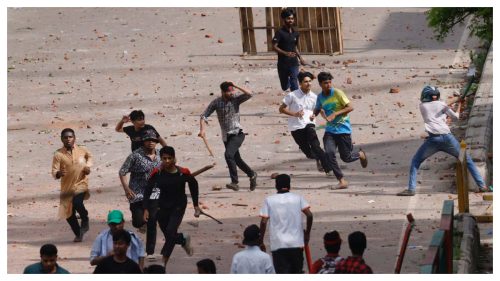
Hasina made hints to the public this week that the plan will be abandoned, which comes after her opponents accuse her government of using the judiciary to further its own agenda.
However, a positive decision is unlikely to calm the nation’s simmering rage in the wake of the intensifying crackdown and growing dead toll.
Business owner Hasibul Sheikh, 24, told AFP, “It’s not about the rights of the students anymore,” while observing a Saturday street demonstration in the capital city of Dhaka against a statewide curfew.
“Our demand is one point now, and that’s the resignation of the government,” he stated.
A system that reserves more than half of civil service positions for particular groups, like as children of veterans of the 1971 war, is the driving force behind the upheaval this month.
Hasina, 76, has ruled the nation since 2009 and won her fourth consecutive election in January following a ballot in which there was no real competition, according to critics who claim the program helps families who support her.
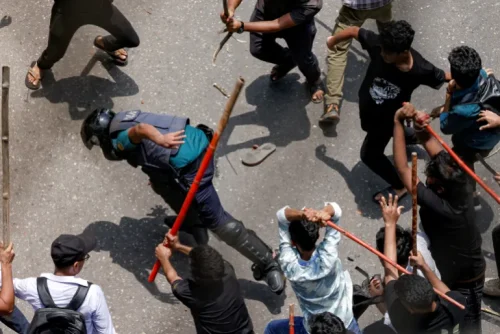
Rights organizations accuse Hasina’s government of abusing state institutions, including as the extrajudicial assassination of opposition activists, in order to strengthen its grasp on power and quell dissent.
Bangladesh’s 170 million people lack access to sufficient employment possibilities, therefore the quota system is a major cause of anger for recent graduates who are struggling to find work.
“The government’s actions have made the situation worse, rather than trying to address the protesters’ grievances,” Pierre Prakash, Asia director of Crisis Group, told AFP.
After a week of increasing violence, Hasina canceled her intentions to depart the nation on Sunday for a diplomatic trip to Spain and Brazil.
Source: The Indian Express
News Asia
Pakistani Government Plans to Ban PTI
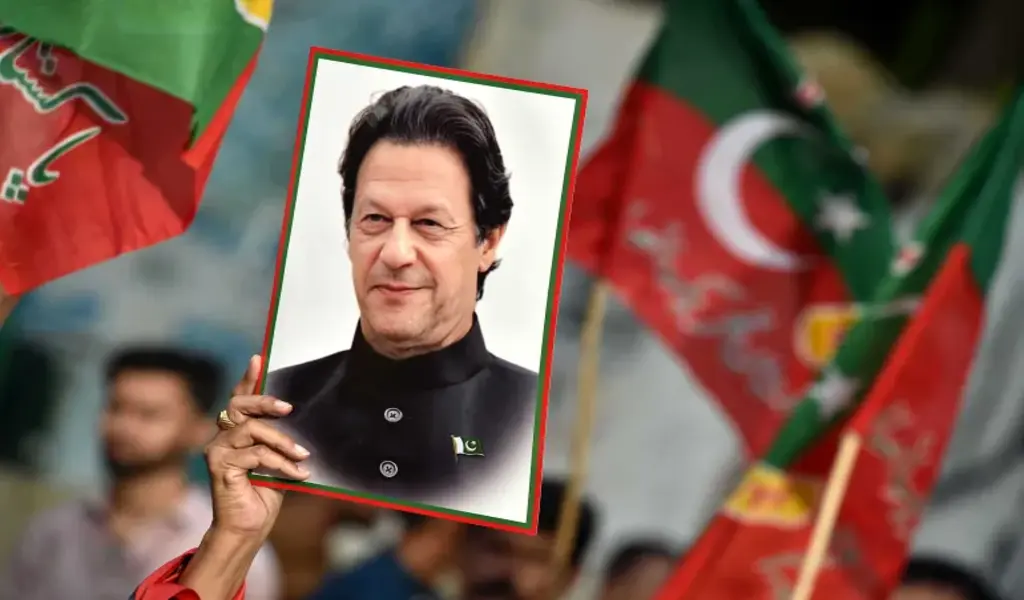
(CTN News) – The Pakistani government has announced measures to outlaw Pakistan Terheek-e-Insaf (PTI), the party of imprisoned former Prime Minister Imran Khan.
Information Minister Attaullah Tarar made the declaration on Monday, only days after the Supreme Court declared the PTI eligible for a share of reserved seats in national and provincial assemblies.
After reviewing all relevant information, the government has decided to ban PTI. “We will file a case to ban the party,” he said, citing claims such as inciting violent protests last year and leaking confidential information.
Tarar stated that the case would be moved to the Supreme Court.
He also stated that the government intended to file treason charges against Khan and two other senior party leaders, former President of Pakistan Arif Alvi and ex-Deputy Speaker of the National Assembly Qasim Suri, as well as a review appeal against the Supreme Court’s ruling that the PTI should be allocated some assembly seats reserved for women and members of religious minorities.
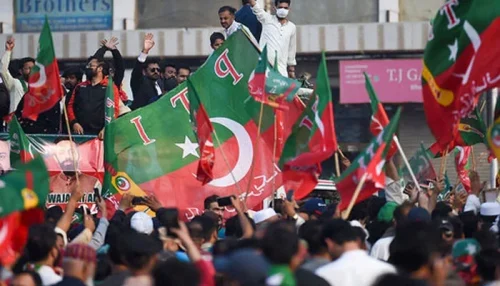
According to Sayed Zulfiqar Bukhari, a top PTI politician and party spokesperson, the government’s action “betrays their complete panic”.
“After realizing that they could no longer threaten, compel, or blackmail judges, they decided to make this move through the cabinet. “All of their attempts to stop us have been declared illegal by the courts,” he stated.
Last week, the Supreme Court recognized the PTI as a political party and confirmed that the party’s lack of an electoral emblem did not affect its legal right to field candidates.
The verdict was in response to the PTI being barred from competing in parliamentary elections in February using its party emblem, the cricket bat, forcing it to field candidates as independents.
Despite the setback, PTI-backed candidates emerged as the largest parliamentary bloc, winning 93 seats.
After Khan declined to cooperate with his political opponents, the Pakistan Muslim League-Nawaz (PMLN) and Pakistan People’s Party (PPP) formed a coalition government with other smaller parties.
Ex-Governor Sindh Zubair, who formerly served in the PMLN, stated that the government’s action was in response to the Supreme Court’s ruling last week and warned of political upheaval ahead.
“The powers that be are trying to disenfranchise the largest majority of voters of the country, who voted for PTI,” he disclosed to Al Jazeera.
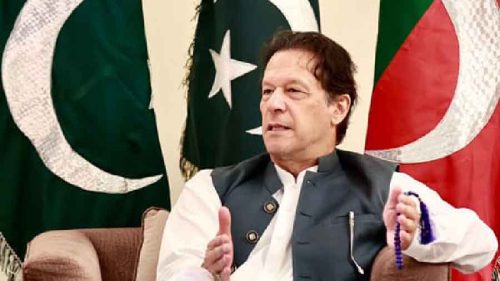
Khan was appointed prime minister in August 2018 but was dismissed from power in April 2022 after a parliamentary vote of no-confidence.
The cricketer-turned-politician has since faced a slew of legal issues, including charges of misplacing and leaking the contents of a confidential cable delivered to Islamabad by Pakistan’s then-ambassador in the US in 2022.
Khan has continually disputed the charge, claiming that the dossier contained evidence that his resignation as prime minister was orchestrated by his political opponents and the country’s powerful military, with assistance from the US administration. Both Washington and Pakistan’s army deny the accusation.
Despite multiple recent court verdicts in his favor, Khan has been in prison since August of last year.
Source: Aljazeera
News Asia
NAB Re-Arrests Imran Khan and Bushra Bibi After Iddat Case Conviction Overturned
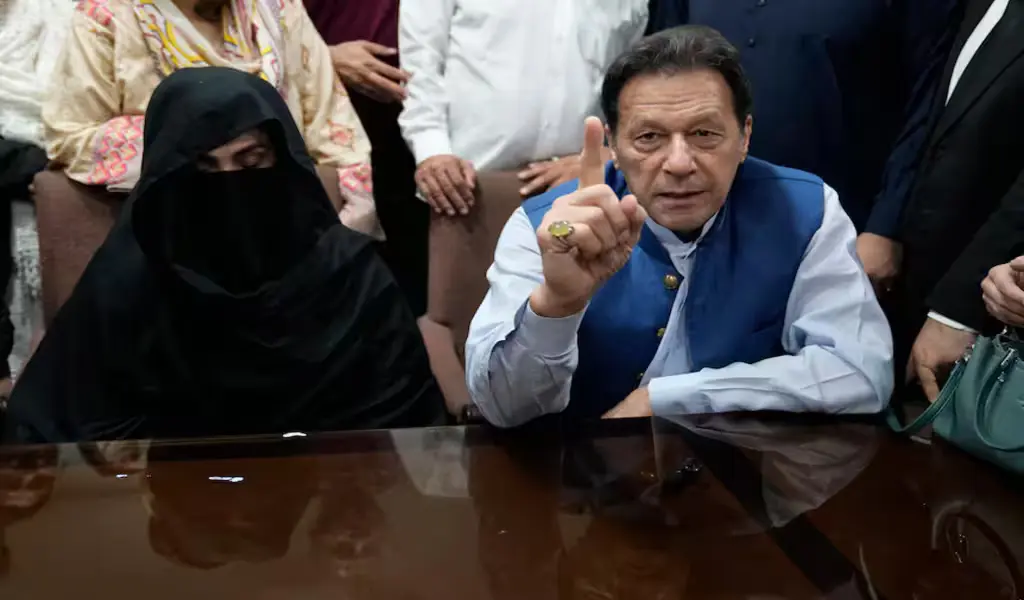
(CTN News) – Former Prime Minister Imran Khan and his wife, Bushra Bibi, were acquitted in the Iddat case by a sessions court on Saturday, less than 24 hours after the Supreme Court ruled in favor of the PTI in reserved seats.
However, their relief was short-lived when Imran Khan was detained by the National Accountability Bureau (NAB) for selling official goods. Bushra Bibi was also rearrested in this case while being released from Adiala Jail’s Gate No. 3.
According to sources, the NAB detained Bushra Bibi after the bureau’s chairman issued arrest warrants for her and Imran Khan. Both are to be investigated in Adiala Jail.
Opposition leader Omar Ayub Khan condemned Bushra Bibi’s imprisonment and criticized the Adiala Jail administration. He also cautioned the jail superintendent of the repercussions and announced that a privilege motion would be filed against him.
Imran Khan and Bushra Bibi were acquitted in the Iddat case after Additional District and Sessions Judge (ADSJ) Mohammad Afzal Majoka reversed their previous verdict, which sentenced them to seven years in prison on February 3, five days before the general election.
Imran Khan’s lawyers, Usman Gill and Zaheer Abbas, were in court when the verdict was pronounced.
In the 28-page ruling, Judge Majoka rejected Khawar Fareed Maneka, Bushra Bibi’s ex-husband,’s arguments that Imran Khan and Bushra Bibi’s nikah was illegally performed and that Mr. Maneka was denied Buju (reconciliation rights) under religious law.
The court also rejected the allegation of fornication under provision 496-B of the Pakistan Penal Code (PPC), stating that no charge was filed under this provision against both Imran Khan and his spouse “because there was no evidence of a second witness”. The trial court heard only one witness, Mr Maneka’s domestic servant.
“In these circumstances, it cannot be said that the appellants committed fornication,” the judge wrote. Regarding the charge of contracting marriage fraudulently during the Iddat period, the judge found that in a video given as evidence during the trial, Mr. Maneka lauded his ex-wife, Bushra Bibi, and “deposed that his ex-wife is a pious lady.”
The magistrate inquired about “how this witness [Mr Maneka] can claim that the appellant No. 2 [Bushra Bibi] committed fraud with him” .
The court announced its decision: “From a perusal of Section 496 PPC and the above-mentioned esteemed citations, this court is of the view that the appellants have not gone through any marriage ceremony fraudulently or with dishonest intention because none of the parties claimed that nikah was not performed and fraudulently he or she was supposed to believe that marriage ceremony was solemnised.”
The court judgment added: “In the instant instance, it is the complainant’s case that the appellants’ nikah was done on January 1, 2018, followed by the second nikah in February 2018. By no stretch of the imagination, it was a marriage with dishonest or deceptive intentions.”
Regarding Mr. Maneka’s claim that he was denied reconciliation rights and so deceived by Imran Khan and Ms. Bibi, the court noted that during cross-examination, Mr. Maneka stated that he learned of the appellants’ marriage on the second day of their nikah.
Before submitting the complaint, the judge questioned why Mr Maneka had been silent on his reconciliation rights for six years.
The judge stated, “The complainant has failed to prove his case against the appellants.” As a result, both appeals filed by appellants No. 1 [Imran Khan] and No. 2 [Bushra Bibi] are accepted, the judgment of the learned trial court of February 3, 2024, is overturned, and both appellants are acquitted of the accusation.”
The court ordered their freedom unless they needed to be imprisoned in other cases.
Source: DAWN
-

 News4 years ago
Let’s Know About Ultra High Net Worth Individual
-
Entertainment2 years ago
Mabelle Prior: The Voice of Hope, Resilience, and Diversity Inspiring Generations
-
News11 years ago
Enviromental Groups Tell Mekong Leaders Lao Dam Evaluation Process Flawed
-

 Health4 years ago
How Much Ivermectin Should You Take?
-

 Tech3 years ago
Top Forex Brokers of 2023: Reviews and Analysis for Successful Trading
-

 Lifestyles3 years ago
Aries Soulmate Signs
-

 Entertainment3 years ago
What Should I Do If Disney Plus Keeps Logging Me Out of TV?
-

 Health3 years ago
Can I Buy Ivermectin Without A Prescription in the USA?